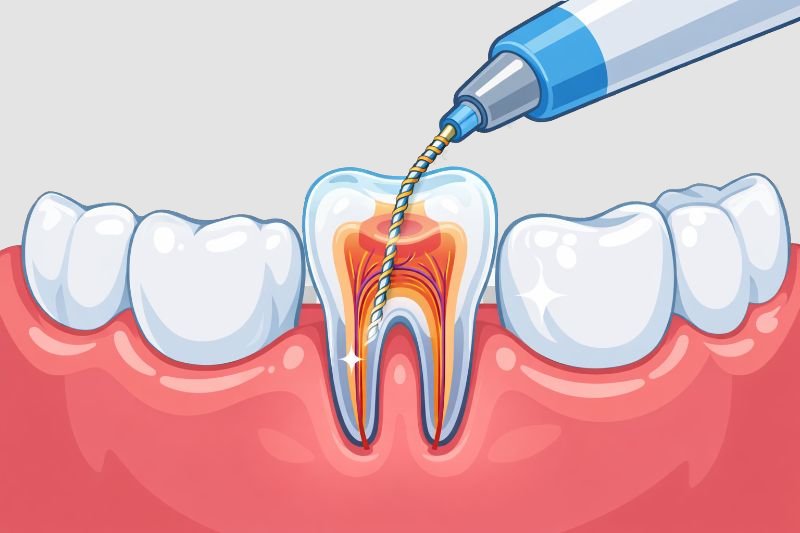
Root canal therapy — endodontic treatment — removes infected or inflamed pulp from inside a tooth, cleans and shapes the canals, and seals them to prevent reinfection. Contrary to popular belief, a modern root canal is no more uncomfortable than receiving a filling. The real pain comes from the infection itself, not the treatment.
At Dentist, Dr. Hartley performs root canal therapy using nickel-titanium rotary instruments, an electronic apex locator for precise measurement, and digital X-rays to verify canal anatomy at every step. Most cases are completed in a single appointment of 60–90 minutes.
When Is a Root Canal Necessary?
Root canal treatment becomes necessary when bacteria reach the soft tissue (pulp) inside the tooth — either through a deep cavity, a crack, or trauma. Once infected, the pulp cannot heal on its own. Without treatment, the infection spreads to the surrounding bone, forming an abscess that may require emergency intervention or tooth extraction.
The Procedure Step by Step
We begin by thoroughly numbing the area — you should feel no pain during the procedure. An access opening is made through the crown of the tooth, and the pulp tissue is carefully removed from each canal using rotary files. The canals are shaped, irrigated with antimicrobial solution, and dried. A biocompatible material called gutta-percha is used to fill and seal the canals. A temporary or permanent crown is then placed to protect and restore the tooth.
Recovery & Long-Term Outcomes
Mild soreness for 1–3 days following treatment is normal and manageable with over-the-counter analgesics. A crown is strongly recommended after root canal therapy to protect the treated tooth from fracture. With a crown, a root canal-treated tooth can last a lifetime.